NES has strengthened its Vegetation Management program to reduce the risk of future storm-related outages for our 460,000 customers.
What You Should Know:
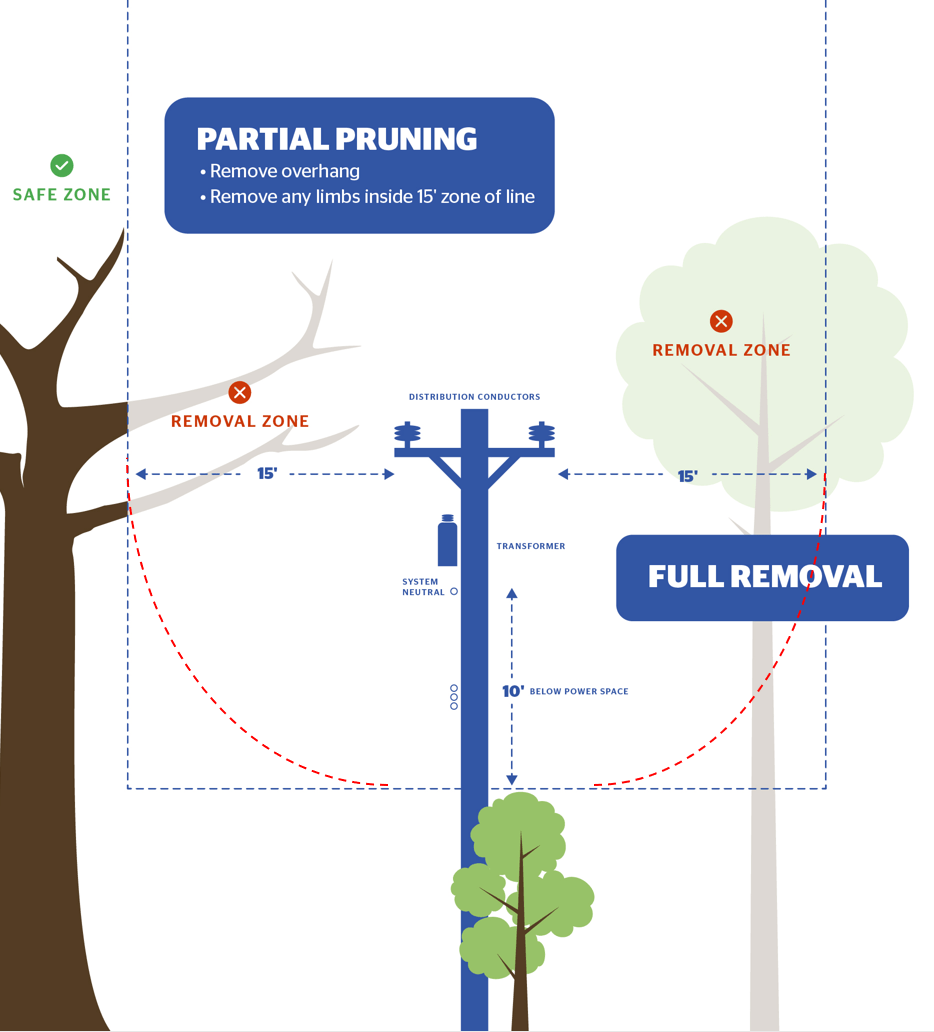
- We've expanded clearances between poles and power line corridors to 15 feet with no overhang.
- Vegetation growing below power lines will be trimmed 10 feet from the power space, which is about 15 feet below the lines.
- June 7, 2026 - Updated graphic to a horseshoe trim zone to maintain 15 feet of radial clearance below the lines
- Trees that cannot be safely maintained at proper clearance may need to be removed.
- Brief, planned outages may occur while crews complete this work safely.
- Power resilience and reliability have increased in areas where trees were trimmed in accordance with these new guidelines.
What to Expect:
- NES crews or our authorized contractors will be working near roads, sidewalks, and utility easements.
- Work occurs near roads, sidewalks, and utility easements may expect to see equipment and experience some noise.
- Questions? Call the NES Tree Trimming hotline at 615-695-7400
Updated Trimming Guidelines & FAQ
-
How will NES contact me?You may receive a voice message, email, or postcard when crews are expected to work in your neighborhood.
-
Why does NES trim trees?Trees growing too close to power lines are one of the most common causes of power outages, especially during storms. Trimming them farther back helps prevent branches from growing into the lines too quickly and reduces both maintenance costs and the chances of outages for you and your neighbors. Our crews follow industry guidelines to trim trees in a way that keeps the electric system safe while also helping the tree stay healthy.
-
How does vegetation management help prevent outages?Trimming trees prevents power disruption. In fact, trees are the single biggest cause of outages in the U.S. Branches touching or falling onto lines cause faults. In Tennessee, this most often happens because of winter ice storms, spring and summer thunderstorms, and straight-line winds. Clear lines are also easier to maintain and repair when outages do occur.
-
Who cleans up the debris after trimming?During normal trimming, our contractors will remove and/or chip tree limbs and debris from your property. However, NES does not remove tree debris caused by a storm, a tree, a fallen limb, or for emergency power restoration. Crews may need to cut down and uproot broken trees to make repairs to our lines, but it is the property owner's responsibility to remove the debris.
-
Will NES ever cut down a tree?Trees growing directly under or within 15 feet of power lines can be difficult to trim. In some cases, it is best to remove the tree. Candidates for tree removal are assessed on an individual basis.
-
What if I don’t want NES to trim my trees?
Trees make our community beautiful and provide many environmental benefits, so NES takes great care in vegetation management. We don't take down trees unless there are safety or grid reliability concerns. Nevertheless, NES has an obligation to its customers to maintain the vegetation in the corridor as part of our commitment to providing reliable power.
General Maintenance
We understand that some customers may choose to hire an arborist for tree trimming or vegetation management. Any arborist performing work within 10 feet of an energized power line must have an OSHA Line Clearance Arborist Certification. During our routine vegetation maintenance, an NES arborist inspects the clearance between vegetation and power lines. If the clearance does not meet NES standards, additional trimming will be needed. Our goal is to collaborate with customers to ensure a safe and satisfactory outcome for everyone involved.During our Routine Vegetation Maintenance
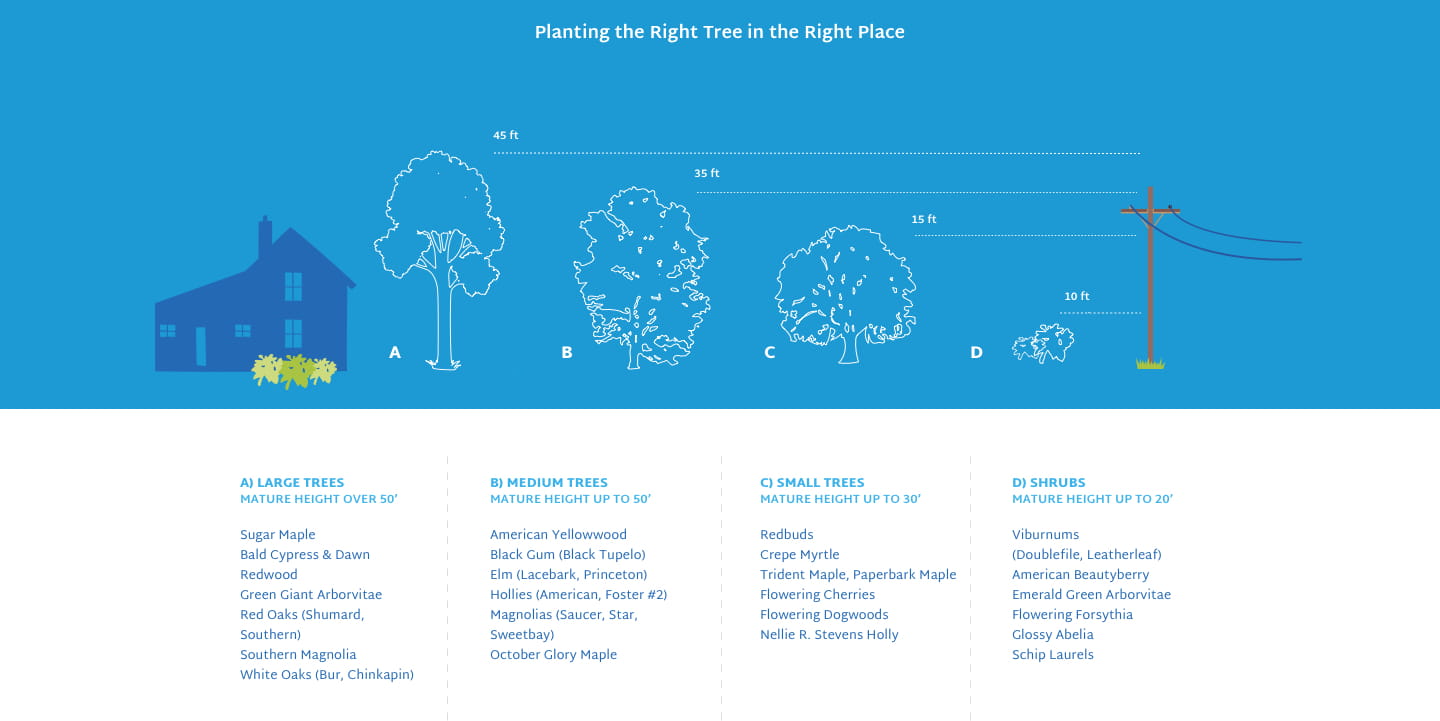
NES facilities are inspected to determine if the clearance between vegetation and power lines is appropriate. When clearance does not meet NES standards, NES must plan to address that infraction. We understand that some customers desire to hire a private company to perform tree trimming or vegetation maintenance as part of their landscape plan rather than have NES vendors perform the work. In that scenario, an assessment must be requested by calling the NES VM hotline. An NES representative will assess the site and advise if this is acceptable and the next steps because anyone performing work within 10 feet of an energized power line must have documented specialized training and certification. Our goal is to collaborate with customers to ensure a safe and satisfactory outcome for everyone involved.Homeowners can help by observing "no grow" zones and planting the right trees in the right places. Planting low-growing vegetation in areas impacted by power lines reduces the need for pruning while still providing cooling benefits to your home. NES' Right Tree Right Place graphic.
-
Can NES legally trim trees?Courts in Tennessee support a public utility's right to trim and remove trees, both within and outside of the right-of-way. According to the Municipal Electric Plant Law of 1935 and the Metro Charter, Appendix III, Article 42, NES has the power to purchase, construct, maintain and improve the electric system and to "do all acts and things necessary and convenient" to carry out the power given.
-
Will NES trim around my service (secondary) line* or the light on my property?
NES only trims near lights or the secondary lines that serve them when requested by NES personnel for maintenance. NES does not trim light patterns for off-road lights (rental lights, parking lot lights, etc.), but routine cycle maintenance for high-voltage overhead lines typically keeps streetlights clear.
NES does not remove trees near service lines*. The homeowner is responsible for tree removal. NES will disconnect service, at no cost, to allow a private tree company to remove the tree.
*A service (secondary) line is a line that goes to the weather head on the house.
-
Where can I get more information on Emerald Ash Borer and Ash tree devastation?You can find more information in our Emerald Ash Borer brochure, or on the Metro Nashville and State of Tennessee websites.
-
Who can I contact for additional questions?Call Customer Relations at 615-736-6900 Monday-Friday, 6:00 a.m. to midnight.

Our Tree Trimming program is an integral part of the power delivery system. We work diligently to manage vegetation growth along each circuit on our system every three to four years. This helps us minimize outages caused by vegetation growing into equipment and the risk of falling onto equipment.
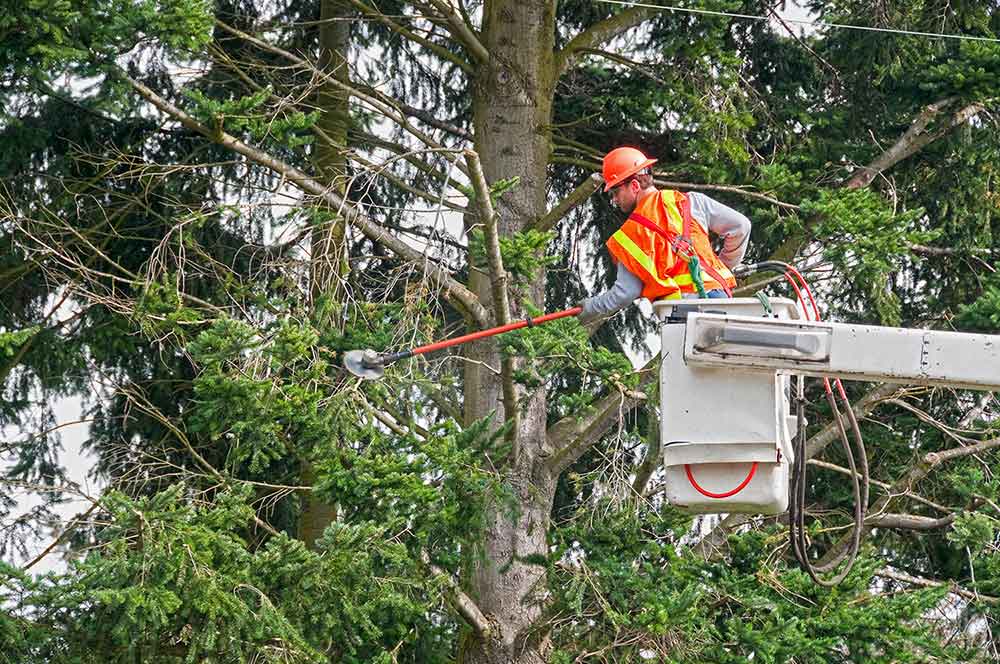
NES follows the lateral pruning method developed by the International Society of Arboriculture (ISA) and approved by the National Arborist Association, the National Arbor Day Foundation, and the Metro Tree Ordinance.
Lateral pruning strengthens the overall structure of the tree, making it more resistant to high winds and heavy ice, while directing future growth away from NES equipment. NES does not promote “topping” or “rounding over” pruning malpractices. These are discouraged because they leave the tree weakened and susceptible to insects and disease.Communications Process
We Want You to Be Informed
If vegetation management is planned for your area, NES will contact you by voice message and email. If you do not have phone or email access, we will send a postcard to your mailing address.
To make sure we have your correct email address and phone number, sign in to My Account and click on "Profile." You can also call the NES Tree Trimming hotline at 615-695-7400 or visit us at 1214 Church Street during regular business hours.
Removals & Plantings
NES requires a safety maintenance zone around each pole, extending at least a fifteen-foot radius, within which all vegetation will be removed.
When power lines are located at the side or rear of a property and are not accessible from a paved or gravel surface, NES requires that all vegetation within fifteen feet of the power line be removed. For safety purposes, this area must be maintained clear of trees or woody shrubs. Vegetation outside this area will be selectively trimmed or removed.
NES will work with property owners to maintain proper clearances in landscaped areas, but retains the right to remove non-compatible vegetation in landscaped areas.
Vines growing on NES poles, guy wires, or other utility equipment are not acceptable and will be addressed.
Pad Mount transformers have a sticker on the box depicting a six-foot clearance for the front door and a three-foot clearance on each side.
Hazard Trees
A hazard tree is a structurally unsound tree, at risk of falling and hitting a target. NES will investigate and assess a hazard tree that could strike NES equipment to determine eligibility for removal. The primary factors in the assessment are:- proximity of the tree to the primary power
- surrounding terrain
- equipment accessibility
- construction type
- voltage classification (service, distribution, transmission).
Hazard trees with trunks or limbs within 15 feet of a power line are candidates for removal and will need to be assessed by an NES Designated Representative (NESDR) to determine if the tree should be removed entirely.
Hazard trees outside 15 feet of power lines and on private property are considered the responsibility of the property owner. NES arborists may remove limbs and/or portions of the trunk that could strike NES facilities if the assessment by the NESDR shows elevated risk to NES facilities. Removal of the remaining tree and disposal of all wood debris are the homeowner's responsibility.
NES Tree Planting Program
Trees growing directly under or within fifteen feet of power lines are difficult to trim and retain their natural aesthetics. In these situations, it is often best to remove the tree. The site and scenario will be reviewed to determine whether they are included in the tree planting program.
NES uses this program to promote the “Right Tree in the Right Place” and to add beauty to our neighborhoods.
Since our Tree Planting program began in 1989, NES has planted more than 65,000 trees and has contributed to many thousands more plantings in the greater Nashville area through our corporate partnerships and sponsorships.
Planting Guidelines